MILOEK
Militärökonomische Forschung und Lehre
Research and Courses in Economics of Defense




Economics and the Economics of Defense VI
The real world features costly information and changing a situation regularly calls for effort. In this setting the decision to invest in deterrence confronts the societies with a prisoner’s dilemma: A rational aggression does not represent an environmental hazard like a volcano eruption, but it is purely “man-made”. Consequently, if all actors refrain from investing in arms (as tools for aggression or for deterrence), the world population would surely be better off. However, as the actors can not enter a synchronized commitment to this goal (it is very tempting to be the one with the guns in a world of unarmed persons), most societies must invest in deterrence or other sanctions against breaches violating the (implicit) global contract. The corresponding costs can be interpreted as an insurance fee.
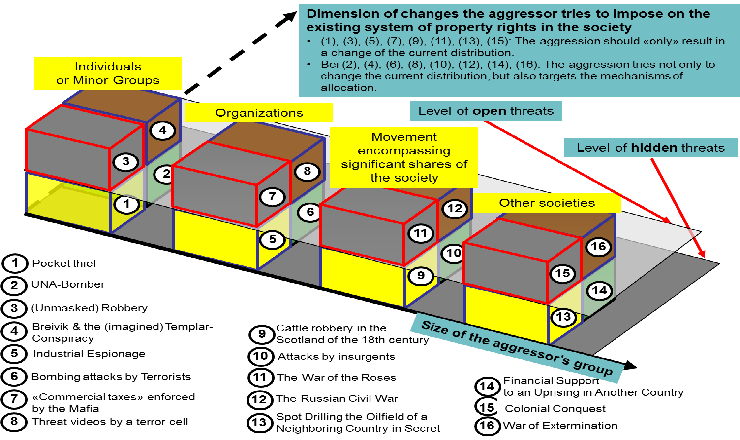
The following graphical representation offers a classification of the various threats to internal security as well as to national security along three dimensions. The examples presented here should be seen as “show cases” because each dimension reflects a (more or less) continuous variable.